

Seoul GPU Showroom · Desktop & Laptop Cards
Browse Our Graphics Cards Catalog
Every card we stock sits in one place, grouped by tier so you compare Intel Arc, AMD Radeon and NVIDIA GeForce families side by side instead of scrolling a flat list.
How this catalog is arranged
The lineup spans Intel's entry-level Arc B570 up to NVIDIA's GeForce RTX 5090, with custom AIB boards from ZOTAC and ASUS sitting alongside mainstream and laptop options. Cards are grouped by tier and by the resolution they realistically serve, so you can start from your monitor and work outward rather than from a spec sheet.
Availability shifts with supply, so treat this catalog as a starting point. Confirm current stock before you plan a build around one specific model, and ask us if you want help narrowing the list.
What you can filter by
- 1440p gaming cards — mainstream tier, modern features
- 4K and creator work — upper tier, tightest stock
- First gaming PC — entry level and value picks
- Laptop or compact build — tell us the chassis
Laptop graphics are fixed at purchase. Compare a notebook against a desktop build at the same budget before you commit.
The eight families on the rack
Open any row to read the back label: the plain facts we keep at the same visual weight as the cooler — memory, power draw, the kind of build each card actually fits into, and what it cannot do.
Intel · AMD · NVIDIA · ZOTAC · ASUS · laptop
B570 Intel Arc B570 — entry level 1080p · lowest cost tier we carry
Where it fits
First gaming PC, a secondary rig, or a media machine on a tight budget.
What it handles
1080p at high refresh rates in most popular titles once paired with a balanced CPU.
Its limit
It won't handle heavy ray tracing or high refresh gaming at 1440p.
Intel's Arc B570 sits below the B580 in the current Arc B-series desktop lineup and aims at affordable 1080p gaming. It is the lowest-cost current-generation option we carry. If you are building your first machine and want the rest of the budget to go to the monitor and the CPU, this is where that conversation starts.
9060 XT AMD Radeon RX 9060 XT — mainstream value 1440p · RDNA 4 · lower power draw
Where it fits
Mainstream 1440p gaming, including compact cases where a short card helps.
What it handles
A serious 1440p contender, with power requirements that are easier to plan around.
Its limit
Not a flagship spec, and ray tracing is lighter than the NVIDIA side of the rack.
Part of AMD's RX 9000 series, built on RDNA 4 and aimed squarely at mainstream buyers. That positioning shows in its power draw and price rather than in flagship numbers. Worth comparing directly against NVIDIA's RTX 5070 if features matter to you as much as frame rate.
See the full RX 9060 XT vs RTX 5070 and RX 7800 XT comparison
7800 XT AMD Radeon RX 7800 XT — previous generation anchor 1440p · RX 7000 series · budget to midrange
Where it fits
Rasterized 1440p gaming on a tighter budget, and price comparisons against newer midrange cards.
What it handles
Still a strong 1440p value card, and builders keep using it as a price anchor.
Its limit
Falls behind current boards on ray tracing and upscaling features.
An RX 7000-series card that has stayed relevant because it does one job well. If your priority is frames per won on rasterized games and you can live without the newest upscaling tricks, it stays in the conversation. We keep it on the shelf next to newer boards precisely so you can see the price gap.
5070 NVIDIA GeForce RTX 5070 — mainstream enthusiast 1440p · RTX 50 series · DLSS 4 support
Where it fits
1440p-focused builds and most mid-tower cases without hero-tier power planning.
What it handles
Modern feature support, including DLSS 4, which matters when you lean on upscaling for high frame rates.
Its limit
Targets the mainstream tier, not absolute top-end 4K builds.
A sensible default for people who want current features without chasing the flagship tier. Power draw and case fit stay manageable, and it is the card most 1440p shoppers end up comparing everything else against.
5070 Ti ZOTAC GAMING RTX 5070 Ti AMP Extreme INFINITY — upper midrange 1440p high refresh · premium AIB board
Where it fits
Builders who want thermal headroom for overclocking or a quieter card under sustained load.
What it handles
Aggressive cooling and a heavier cooler shroud built around an upper-tier RTX 50-series GPU.
Its limit
Physically larger than a reference board. Check case clearance before you commit.
ZOTAC's GAMING line covers GeForce partner cards, and AMP Extreme INFINITY is a premium board variant. The reason to pick this over a plainer card is the cooler: it holds clocks longer, runs quieter, and leaves room if you want to tune it. Measure your case first — this is not a card that squeezes into a small chassis.
5090 NVIDIA GeForce RTX 5090 & ASUS ROG Astral — flagship 4K · creator workloads · tightest stock
Where it fits
High-end 4K gaming and creator workloads where time saved on renders matters.
What it handles
The top-end card in NVIDIA's current RTX 50-series desktop lineup, and ASUS's premium ROG Astral build of it.
Its limit
Case size, power delivery and noise decide the build as much as raw speed. Stock is the tightest segment we carry.
At this level the deciding factors stop being frame counters and become cabinet clearance, the power supply you already own, and how loud you can tolerate the room getting. The ROG Astral sits at the premium end of GeForce partner cards, built around the flagship GPU tier with extreme cooling and heavy build quality. If the RTX 5090 is on your shortlist, read the dedicated guide before you commit.
5070 L NVIDIA GeForce RTX 5070 Laptop GPU — portable laptop · RTX 50 series notebook lineup
Where it fits
Thin-and-light gaming laptops used for work and play on the same machine.
What it handles
The modern RTX 50-series feature set carried over to a portable chassis.
Its limit
Fixed at purchase. The model you choose is the one you keep for the life of the laptop.
Listed in NVIDIA's RTX 50-series notebook lineup and relevant to mainstream laptop buyers in Korea who want one machine for everything. Because laptop graphics cannot be swapped later, compare it against a desktop build at the same budget before committing — a desktop at that price usually buys more gaming headroom, a laptop buys portability.
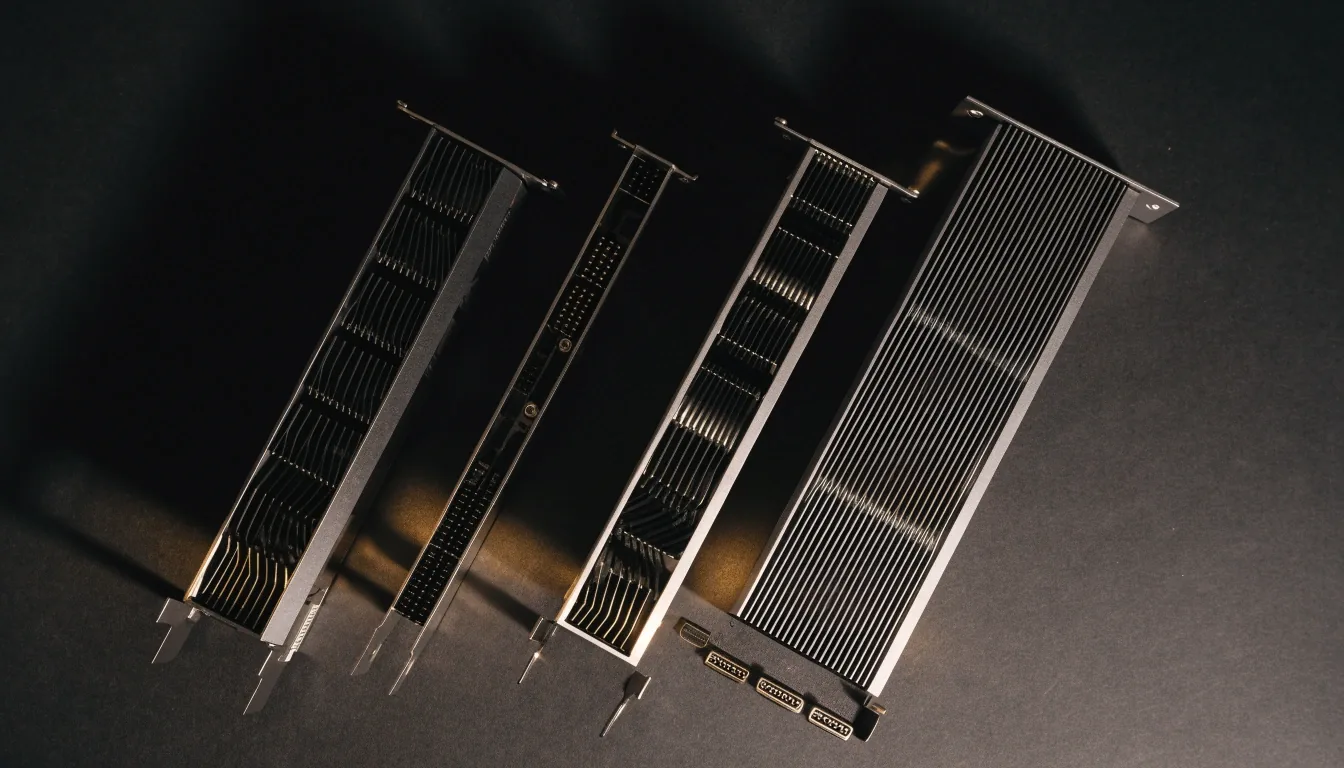
Choosing by resolution: 1080p, 1440p, or 4K
Resolution is the fastest way to cut this catalog down. Start from the monitor you own or plan to buy, then work backwards to the card.
1080p
The Intel Arc B570 and the mainstream midrange cards cover high refresh rates without overspending. This is where a first build should start if the monitor is still 1080p.
1440p
The RTX 5070, RX 9060 XT and RX 7800 XT are the realistic contenders. The RX 9060 XT and RTX 5070 carry newer upscaling features; the RX 7800 XT usually wins on straight price per frame.
4K and creator work
The upper-tier cards and the RTX 5090 enter the frame. Above 1440p, memory capacity and power delivery start to matter more than clock speeds.
Tell us the resolution and refresh rate of your monitor and we will cut the list down to the two or three cards that actually make sense for it.
Before you pick a tier
- Match the card to the monitor, not to the game you played last week.
- Check your case clearance before upper-midrange and flagship cards — those shrouds grow fast.
- Count your power supply connectors before you count frames.
- Confirm stock before you plan a build around one specific model.
VRAM and feature comparison
Memory capacity and feature support separate these cards as much as raw speed does. Entry-level cards typically carry less VRAM suited to 1080p, while 16GB-class boards give headroom for 4K textures. DLSS and AMD's equivalent upscaling both help you hit higher frame rates, and ray tracing performance still varies between vendors. We list capacity and features per model so you can weigh them against the games you actually play.
| Graphics card | Role in the lineup | Target resolution | Memory class | Stock note |
|---|---|---|---|---|
| Intel Arc B570 | Entry-level current generation | 1080p | Budget tier, less memory headroom | Usually available |
| AMD Radeon RX 9060 XT | Mainstream value | 1440p | Mainstream tier | Steady supply, varies by board |
| AMD Radeon RX 7800 XT | Previous-generation price anchor | 1440p rasterized | Midrange, older feature set | Limited to remaining units |
| NVIDIA GeForce RTX 5070 | Mainstream enthusiast default | 1440p | Mainstream, modern features | Fluctuates with supply |
| ZOTAC GAMING RTX 5070 Ti AMP Extreme INFINITY | Premium AIB board, cooling-led | 1440p high refresh | 16GB-class board, large cooler | Ask before planning a build |
| NVIDIA GeForce RTX 5090 / ASUS ROG Astral | Flagship, top of the catalog | 4K and creator workloads | 16GB-class and above | Tightest segment, confirm first |
| NVIDIA GeForce RTX 5070 Laptop GPU | Portable equivalent | Internal panel, typically 1440p | Notebook tier, fixed at purchase | Depends on laptop model |
Memory class describes the tier a card sits in rather than a single number, because partner boards within one family can differ. Ask us for the exact board and we will tell you what is on the shelf today. Stock moves with distributor supply, so no line above is a promise of availability.
The back label matters more than the cooler shroud, and we set it that way.

Power draw, memory bus, card length and cooler type decide whether a card actually drops into your build. We list those before the frame-rate talk, because a card that fits beats a card that benchmarks well on a shelf. Bring your case model and power supply rating and we will check the fit with you before you pay.
This is also where we are honest about the things marketing pages skip: entry cards with less memory headroom, laptop parts that cannot be upgraded, and flagship stock that simply may not be there next week.
Questions we get at the counter
Short answers to the things people ask before they commit to a tier. If yours is not here, call the shop or send it through the contact page.
Is the Intel Arc B570 enough for modern games? entry
For 1080p at sensible settings, yes for most popular titles, provided the CPU around it is balanced. It is not a card to buy if you already own a 1440p high-refresh monitor, and it will not carry heavy ray tracing.
RTX 5070 or RX 9060 XT for 1440p? 1440p
Both are legitimate 1440p cards. The RTX 5070 leans on NVIDIA's feature set, including DLSS 4 upscaling; the RX 9060 XT usually sits at a lower power draw and price. If you mainly play rasterized games and watch the budget, the AMD card is worth a serious look. If upscaling and ray tracing matter to you, pay the NVIDIA premium. Our midrange comparison walks through the trade-offs row by row.
Is the RX 7800 XT still worth buying? value
It stays in the conversation for rasterized 1440p gaming on a tighter budget. It gives up ground on ray tracing and newer upscaling features, so buy it for frames per won rather than for feature parity with current boards. Supply is limited to what remains in the channel.
Will this card fit inside my case? fit
Upper-midrange and flagship boards are physically larger than reference designs, and premium cooler shrouds add both length and thickness. Bring the case model with you and we will measure against the card on the shelf. It is far cheaper to check than to return.
Laptop GPU or a desktop build at the same budget? laptop
A laptop buys portability and one machine for work and play. A desktop at the same money usually buys more gaming headroom and can be upgraded later. Because laptop graphics are fixed at purchase, decide which of those you actually need before you spend.
How do I know which cards are in stock? stock
Ask us. Supply moves with the distributor, and the catalog here describes the tiers we carry rather than a live inventory count. Call the shop, send us the model you want through the contact page, or read how we track prices and stock before you plan a build around one specific card.
Not sure which tier your build belongs in?
Send us the monitor, the case, the games you play and what you want to spend. We will come back with the two or three cards from this catalog that actually fit, plus what we would leave out. Visit the shop in Gangnam or write to us first — either way we answer with parts, not a sales pitch.
88, Teheran-ro 87-gil, Gangnam-gu, Seoul · +82-2-552-8890 · Mon–Sat 10:00–20:00